What It Costs to Run a Startup Incubator: The Real ROI of the Idea to First Dollar Program
What It Actually Costs to Run the Business Readiness Program’s Idea to First Dollar Startup Incubator
The Real Cost of Running the Idea to First Dollar Startup Incubator
Why BRP Covers the Cost for Founders
Why the Long-Term Impact Matters
Supported Businesses Last Longer
Why Survival Drives Economic Return
How Economic Ripple Effects Are Actually Calculated (RIMS II Style)
Overview of RIMS II | RIMS II User Guide
What This Model Does Not Measure
A Clear, Cohort-Based Economic Impact Model
What It Actually Costs to Run the Business Readiness Program’s Idea to First Dollar Startup Incubator
When people hear that the Idea to First Dollar Startup Incubator is free for participants, the next question is almost always the same:
“How does that work?”
The short answer is that it works because the program is intentionally funded through grants, sponsorships, and community investment. The long answer is below.
This post is about transparency. Running a high-quality, outcomes-driven business incubator costs real money, even when participants do not pay out of pocket.
This breakdown is intended for funders, sponsors, partners, and community stakeholders who want to understand how resources are used and why the investment matters long term.
Why This Matters
Idea to First Dollar Startup Incubator is not a webinar series.
It is not a motivational talk.
It is not a download-and-good-luck program.
The Idea to First Dollar Startup Incubator, operated by the Business Readiness Program, is a structured, in-person incubator. It combines coaching, accountability, practical education, and a real pitch competition that puts actual dollars into the hands of new business owners.
That requires planning, staffing, space, tools, and prize funding.
TL;DR
One Idea to First Dollar Startup Incubator cohort costs $37,000
That supports 10–15 founders
Cost per founder is $2,466–$3,700
Research shows supported businesses survive at much higher rates
Using conservative RIMS II–style modeling, one cohort can reasonably generate $1.7M–$2.55M in five-year local economic activity
That is $46–$69 returned per $1 invested, modeled transparently and conservatively

The Real Cost of Running the Idea to First Dollar Startup Incubator
The Idea to First Dollar Startup Incubator is an 8-week, in-person program serving 10 to 15 founder participants per cohort.
Total investment per cohort: $37,000
Cost Breakdown
Program Operations: $30,000
This is the core cost of running the incubator and includes:
Curriculum development and updates
Eight weeks of in-person facilitation
Group and individual coaching
Program coordination and administration
Participant tracking, reporting, and compliance
This reflects the real labor and infrastructure required to run a hands-on incubator responsibly. It does not include participant stipends, equity positions, or founder fees of any kind.
Pitch Competition Grants: $3,500
1st place: $2,000
2nd place: $1,000
3rd place: $500
These grants are unrestricted and are intended to remove immediate barriers such as licensing, equipment, marketing, or inventory.
Pitch Event Costs: $3,500
This covers the cost of running a professional, in-person pitch night, including:
Venue and setup
Audio and visual needs
Event logistics and materials
Cost Per Founder
With 10 to 15 founders per cohort, the investment equals:
$3,700 per founder at 10 participants
$2,466 per founder at 15 participants
Many accelerator and incubator programs nationally charge founders comparable or higher amounts through fees, equity, or long-term commitments. Business Readiness Program (BRP) absorbs this cost so founders can participate without taking on additional financial risk.
Why BRP Covers the Cost for Founders
Early-stage founders already carry personal and financial risk.
The Business Readiness Program funds the Idea to First Dollar Startup Incubator through grants, sponsorships, and community investment so that:
Cost is not the barrier at the idea stage
Founders invest effort and execution, not debt
Communities benefit from stronger business survival rates
This is not charity. It is economic infrastructure. A common question that follows any cost breakdown is whether those costs are reasonable or typical.
Are These Costs Reasonable?
There is no single price tag for incubators, but research consistently shows that structured, high-support incubators operate in this range and are considered cost-effective economic development tools.
Helpful references:
New Mexico Economic Development Department, business incubator outcomes and cost effectiveness
University of Nevada, Reno Extension, incubators as a local economic development strategy
Business News Daily summary citing higher survival rates for incubated businesses
Why the Long-Term Impact Matters
The real value of the Idea to First Dollar Startup Incubator is not confined to the eight weeks founders spend in the room.
The return on this work shows up over years.
When early-stage businesses receive structured support at the beginning, they are more likely to survive the most fragile phase of business ownership. Survival is what turns ideas into employers, side hustles into primary income, and early momentum into long-term contribution to the local economy.
That is the outcome BRP is designed to influence economic growth.
Supported Businesses Last Longer
National data shows that many businesses do not make it past the five-year mark when they are started without structured support.
According to the U.S. Small Business Administration, approximately 49 percent of businesses survive five years without formal assistance. Source: SBA FAQ About Small Business
In contrast, reporting from business incubators and economic development agencies commonly cites five-year survival rates between 85 and 87 percent for businesses that participate in incubator programs. Sources: NM Community Development Business Incubator Certification, 272 Incubators Increase Small Business Success
Even when these figures are treated as directional rather than guaranteed, the takeaway is consistent. Businesses that receive structured guidance, accountability, and access to a founder community are significantly more likely to still be operating years later.
Longevity is the foundation of economic impact.
Why Survival Drives Economic Return
A business that survives longer does more than exist.
It generates ongoing revenue, pays vendors, supports service providers, reinvests locally, and in many cases begins to hire. The economic benefit compounds year over year because the business does not have to start over from zero.
This is why BRP focuses on early structure, clarity, and execution rather than short-term wins or surface-level education.
How Economic Ripple Effects Are Actually Calculated (RIMS II Style)
Economic impact is not calculated by simply multiplying the program budget once.
Instead, economists use input-output models, such as RIMS II from the U.S. Bureau of Economic Analysis, to estimate how business activity ripples through a local economy over time.
RIMS II models three types of effects:
Direct effects: The immediate business activity itself, such as business receipts and owner income.
Indirect effects: Spending by businesses on suppliers, professional services, and operational needs.
Induced effects: Household spending by business owners and employees as income circulates through the community.
Source: Overview of RIMS II | RIMS II User Guide
For the Business Readiness Program, the most meaningful economic impact comes from businesses that continue operating over multiple years, not from the one-time expense of running a cohort.
What This Model Does Not Measure
This economic impact model is intentionally conservative.
It does not attempt to measure:
Founder wages beyond reported business receipts
Long-term hiring beyond year five
Secondary businesses launched by participants
Reduced costs associated with business failure and restarts
Social and community benefits such as leadership development, confidence, or local engagement
These impacts are real and meaningful, but they are harder to measure consistently. As BRP collects more longitudinal data, future models can be refined using actual local outcomes.
A Clear, Cohort-Based Economic Impact Model
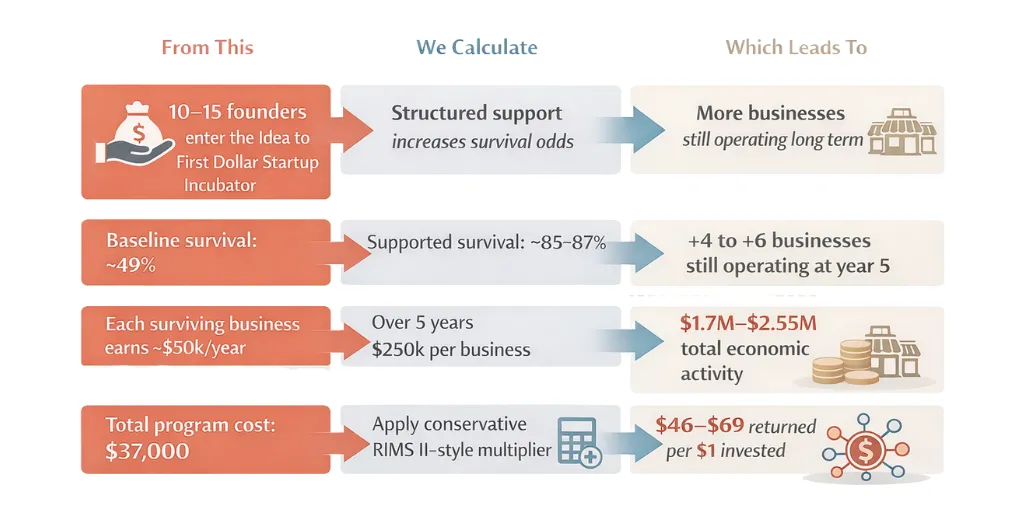
Because the Idea to First Dollar Startup Incubator serves 10 to 15 businesses per cohort, the economic ripple is driven by how many of those businesses survive and grow over time.
The impact is not created by multiplying the $37,000 program cost once. It is created by increasing the number of businesses that are still operating, earning, and reinvesting locally five years later.
Below is a transparent, conservative way to estimate that impact.
Cohort-Based Economic Impact Model


How to Read This Model
This model does not assume every business succeeds.
It models the difference structured support makes over time. The economic impact comes from additional businesses that remain open, continue generating revenue, and reinvest locally over a five-year period.
All assumptions are intentionally conservative and grounded in publicly available research. A localized RIMS II analysis would allow for even more precise estimates in the future.
Why This Investment Is Worth It
At its core, the Idea to First Dollar Startup Incubator functions as economic infrastructure.
By increasing the number of businesses that survive, operate, and grow locally, the Business Readiness Program turns a single cohort investment into multi-year economic activity. The time, effort, and expense required to run each cohort are not sunk costs. They are inputs into a system designed to produce durable, compounding returns for the community.
That is why this work matters, and why the investment pays off.